





 EN
 AR
 NL
 FR
 IT
 JA
 KO
 PT
 RU
 ID
 MS

[NEW LAUNCH] A Must-Try Classics From China Tea, AT102 Yellow Tin Laocong Shuixian
As one of the super-hit items in China Tea's “National Tea for Daily Drinking” Series with a 68-year-long sale history, Yellow Tin Laocong Shuixian sells an average of 801,879 tins annually, a figure, fully reflecting its solid reputation in the market.
Deep in the memory of the older generation of overseas Chinese in Southeast Asia, there are two colors having remained vivid as original for long, the “Red Tin” and the “Yellow Tin”, the "Twin Tins". The bright, warm yellow one belongs to the AT102 Laocong Shuixian. 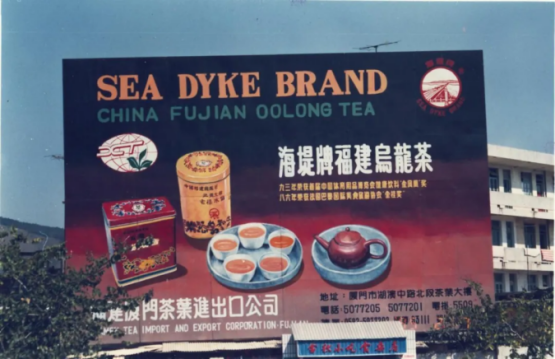
A Yellow Tin billboard of the 1980s to the early 1990s
In the memory of countless overseas Chinese, China Tea Sea Dyke AT102 Yellow Tin Laocong Shuixian has long been more than a tea, it is a family letter you can brew, a milestone of Chinese Oolong tea export, and a timeless classic China Tea Sea Dyke has kept unfaded for over 70 years.
I. The Mark of an Era: The Devotion of Tea Export for Oversea Chinese, From Homeland to Cup
Back in the early years of New China, tea was given an unprecedented historic task: to earn foreign exchange through export, and to support national construction. At that time, Fujian, as the core producing area of Chinese oolong tea, shouldered the responsibility.
In 1954, the Xiamen office of China Tea Fujian Branch, the Predecessor of China Tea(Xiamen), was established. In January 1955, China Tea Fujian Branch began exporting tea directly, with the Xiamen Office specializing in "Qiaoxiao tea" — tea exported specifically to overseas Chinese communities in Southeast Asia. A cup of home-flavored Oolong tea became one of the finest solace for their homesickness.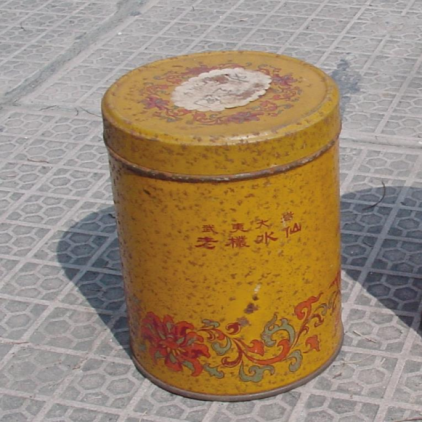
The Yellow Tin of the 1950s
In the late 1950s, China Tea (Xiamen) began the R&D on the standardized small-package tea for export and created an coding system pre-fixed with “AT”. AT is short for "AMOY TEA" (Amoy, the traditional international name for Xiamen). Each mark stands for a single product with standardized production, stable, consistent quality and ample supply for massive export. This coding system can be called the "Esperanto" for Chinese oolong tea going global. In 1958, AT102 was packaged in yellow tin officially launched, with the name of Laocong Shuixian. Since then, it has fondly been called the“Yellow Tin”.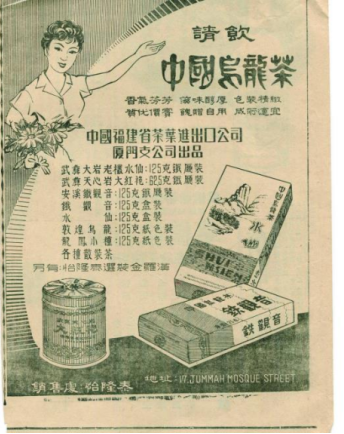
In November 1964, Sea Dyke products were advertised in Singapore
When AT102 was first introduced, it was reserved for Chinese communities in Southeast Asia; back home, it was a rarity that could only be bought with FX coupons. At the time, drinking Sea Dyke Yellow Tin tea was a mark of taste and status — as much as wearing a Rolex watch or driving a Hongqi car. It was also a treasured gift among family and close friends.
II. Quality Endorsed: Craftsmanship Held Fast from the Mountain Plot to the Tin
As a classic of China Tea, the reason why AT102 Yellow Tin Laocong Shuixian has stayed popular for more than half a century not only lies in the nostalgia alone, but also the stable, consistent quality. From the Wuyi mountain terroir to the tin can in consumer's hands, every single step follows extremely strict standards, never slackened in more than half a century.
The natural environment of Wuyi mountain provides an optimal growth condition for tea trees. As the saying goes: nothing as mellow as Shuixian, nothing as fragrant as Rougui, nothing as charmful as Da Hong Pao. A clear consensus has been reached within tea industry: only Shuixian bushes with over 50-year age can be deemed as Laocong(old bush). Unlike ordinary Shuixian, due to being older, Laocong(old bush) have accumulated richer aromatic substances and inner components in its tea leaves. In appearance, the dry tea is dark brown and glossy in color, with plump and robust strips. From the inner quality perspective, it develops the unique "Cong flavor" (bush character). The mountain terroir endows the tea with rock charm(yan yun), while time endows it with bush charm (cong yun). Blended in harmony, they jointly form the innate endowment of Laocong Shuixian that cannot be copied.
Made from Laocong Shuixian sourced from the Wuyi Mountain scenic area, refined through Sea Dyke traditional roasting, this product delivers rich aroma with an evident orchid note, pure, mild flavor, and a lingering finish.
Many older Xiamen locals often call Sea Dyke tea "soy-sauce tea", because the orange-red, bright, deep tea liquor like soy sauce is the signature look of heavy roast rock tea. Behind that "soy-sauce colour" is the persistence to the traditional techniques. In a fast-paced society seeking light roast and refreshing aroma, China Tea Sea Dyke still insists on heavy, slow roast, obtaining mellow, thick tea soup and the quality fit for long-term preservation. “Strong is not thick, light is not thin", the heavy roast can remove the grassy astringency and dryness of fresh tea leaves, allowing the liquor "mellow, thick and sweet ", and the rock charm to fully unfold in the water.
In 2022, the "Xiamen Oolong Tea Traditional Refining Technique" by China Tea(Xiamen) was inscribed on the 6th batch of the city-level Intangible Cultural Heritage list. For centuries, generation after generation of tea masters have long been adhering to the complete processing techniques, including sun-withering, shaking, fixing, rolling and roasting. Traditional hand-making relies on the their experiences and it is hard to make the flavor standardized.
After the founding of New China, China Tea(Xiamen) began exploring the standardized, scaled refining process of Wuyi rock tea. Sea Dyke people went deep into Wuyi producing areas, combining ICH craft with modern refining techniques to achieve stable, controllable flavor, while keeping the character of rock tea. Consequently, the authentic Wuyi Laocong Shuixian could break through regional limits and be shipped in large volume to both domestic market and overseas market. AT102 Yellow Tin Laocong Shuixian is the major representative of that standardized process system. Whether at home or overseas, whenever a yellow tin is opened, that familiar, stable aroma comes.
III. Keeping Alive: Product Iteration From Classic to China-chic
With the rise of the China-chic, more and more young people have become increasingly interested in traditional tea culture. With more than half a century of history, the product has shouldered the new cultural mission. For many younger consumers, it is just this highly recognizable tea, making them first understand the charm of Laocong Shuixian, as well as the history, culture behind the Chinese rock tea. This small yellow tin, like a cultural messager, is playing a vital role.
More importantly, through craft upgrade and limited numbering system, this "National Everyday Tea" is being given a collectible, heirloom value. 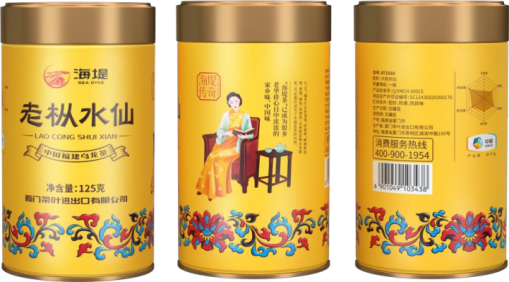
New version of The Yellow Tin
From the hard start at No.122 Zhongshan Road in 1954 to today's glorious map covering 59 countries and regions, China Tea Sea Dyke will continue to safeguard the classic while bringing forth the new, be deeply rooted in the Wuyi rock tea industry chain, and keep drawing out the cultural meaning of the old products. The company will stay committed to spreading the unique charm of Chinese tea culture to across the world with cups of quality fine tea. This iconic Yellow Tin Lacong Shuixian will carry its aroma to every corner of the world.